
Big data, small repo: scaling PortalJS data with Giftless and Cloudflare R2

Anuar Ustayev
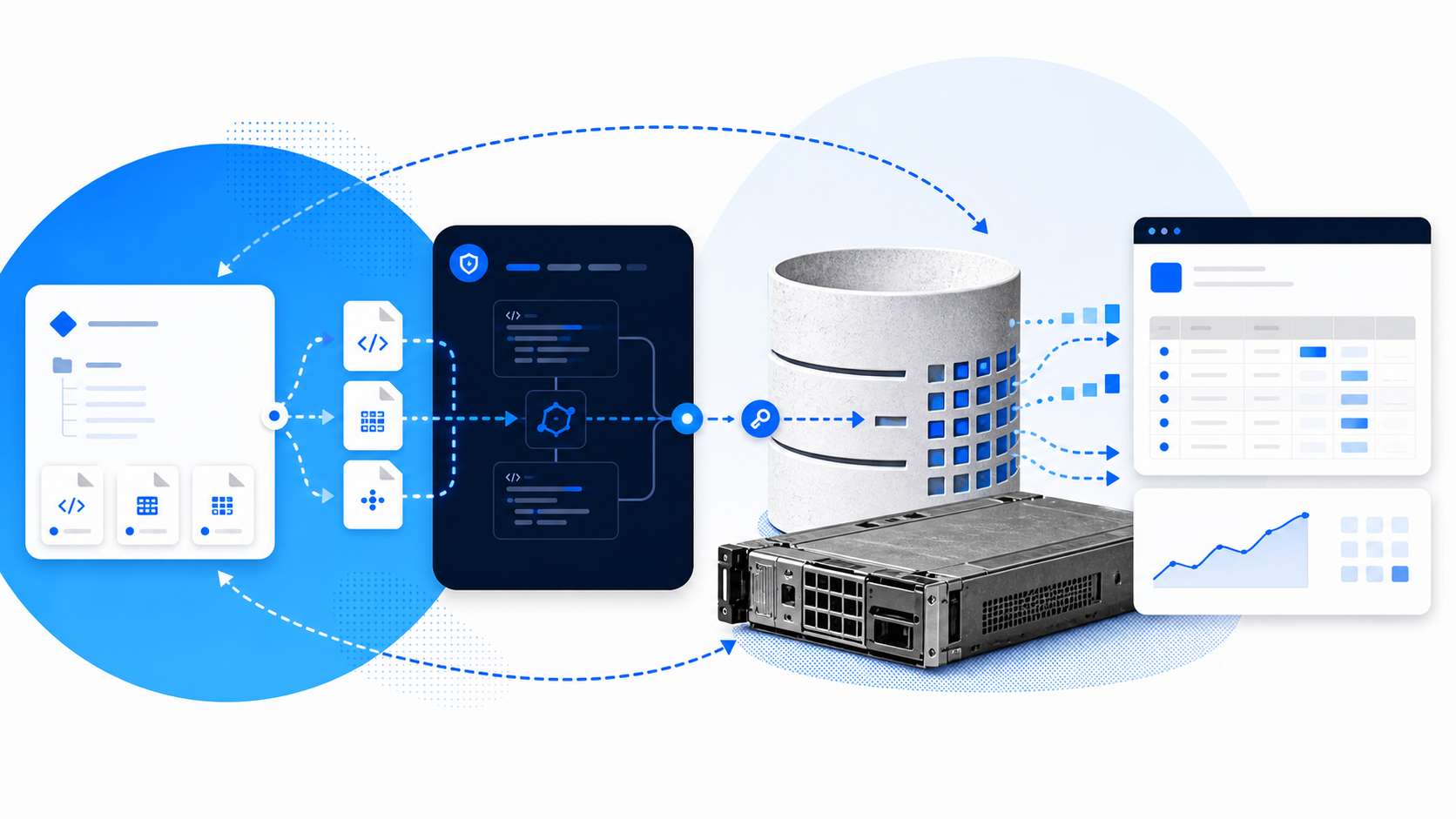
A data portal is only as good as the data in it. And real data is big — multi-hundred-megabyte CSVs, Parquet files, GeoJSON boundaries. The moment you try to put that in a git repo, things break: GitHub rejects files over 100 MB, clones balloon, and your static build chokes trying to bundle it all.
So most portals punt: they link out to a file on some bucket, by hand, and the data drifts away from the code that describes it.
We wanted something better for PortalJS — keep authoring git-native, but stop shoving bytes into git. Here's how that works, and why we built it the way we did.
The idea: pointers in git, bytes in object storage
Git LFS (Large File Storage) is the right primitive. A tracked file becomes a tiny ~130-byte pointer committed to git; the actual bytes are stored elsewhere and fetched on demand. Your repo stays small and fast, your data stays versioned alongside it, and git still works exactly as you expect.
The question is where the bytes go and who brokers them. That's where Giftless comes in.
Giftless + Cloudflare R2
Giftless is Datopian's open-source, pluggable Git LFS server. We run it on Cloudflare Containers, backed by a Cloudflare R2 bucket (S3-compatible object storage, no egress fees).
The design choice that makes it cheap and fast:
git-lfs ──JWT──▶ Giftless ──▶ signs a presigned R2 URL
   │                                    │
   └──── PUT/GET bytes ───────────▶ Cloudflare R2  (directly)
File bytes never transit Giftless. It only validates your token, brokers the LFS metadata, and signs a short-lived presigned URL. Your client then uploads or downloads straight to R2. That makes the server a light, low-bandwidth, scale-to-zero workload — it costs almost nothing to run and there's no bandwidth bottleneck in front of your data.
R2 is the same storage layer PortalJS Cloud already uses, S3-compatible so any tool speaks to it, and free of the egress fees that make object storage expensive elsewhere.
You never have to touch any of this
Here's the part that matters for everyday use: if you don't know what Git LFS is, you never need to.
In PortalJS, you work with an AI agent. When you run /portaljs-add-dataset and point it at a local file, the skill decides where the bytes belong (big local files → R2 via LFS, bundled samples → inline, remote URLs → passthrough) and does the whole dance for you — tracking the file, getting a scoped upload token, pushing the bytes to R2, and registering the dataset in your catalog. No git lfs track, no credentials to copy, no manual config.
(This clip streams from a Cloudflare R2 bucket — the same object storage the datasets themselves live in.)
Then your deployed portal serves that data straight from R2. Pair it with DuckDB-Wasm over Parquet and you can query a large dataset right in the browser — no download, no server, range-requesting only the bytes a query needs.
Auth: the signing key never leaves the server
Git LFS needs authentication, and we didn't want a long-lived secret sitting on anyone's laptop. So PortalJS Arc acts as the token issuer: it authenticates you, confirms you own the repo, and mints a short-lived, repo-scoped RS256 token. Giftless verifies it with the public key. The private signing key stays a server-side secret — it's never distributed to clients.
Tokens are least-privilege by default (read-only unless you're pushing), scoped to a single repo, and expire in an hour. A clean, boring security posture, which is exactly what you want.
Open by default
Like the rest of PortalJS, none of this is a lock-in. Giftless is open source and self-hostable: point it at your own S3-compatible bucket and run the same setup without Arc. The .lfsconfig in your portal is just a URL — swap it for your own host any time.
It's live
This is live in production now, backed by Cloudflare R2 — nothing to set up. Spin up a portal, add a real dataset, and watch a 200 MB file land in object storage while your repo stays tiny:
npm create portaljs@latest my-portal
Then tell your agent to add your data. ⭐ Star us on GitHub and come build with us in Discord.